Qualitative
The journal captures what shows up in the work: good prompts, broken assumptions, clean handoffs, and needless loops.
Organization theory meets agentic coding
A workshop, the initial setup, and clear next tasks get you through phase 0 and 1. After that, your team carries phase 2 and 3 forward on its own.
Agentic coding rarely fails in the first demo. It fails in day-to-day work when review, quality gates, and learning do not grow as a system.
Your fastest people get stuck in review while agents produce more and more. That cuts throughput and makes quality depend on a few calendars.
What gets checked before merge changes from person to person, repo to repo, or day to day. The agent never sees a stable target.
Without a journal and measurement, every good or bad outcome stays a one-off. The team repeats mistakes instead of turning them into better prompts, rules, and tasks.
I combine organization theory with agentic coding. We first build the working shape in which agents can contribute reliably: roles, gates, handoffs, and clear ownership.
I track two levels with you: qualitatively in the journal, quantitatively in the signals from hooks, logs, SQL, and traces.
Day 1 is workshop and setup in one move. I put the foundation in place with you and work through the concepts until it is clear how you continue without me.
In the best case, one shared start is enough. After that your team implements the rest on its own.
You do not need a huge library to get started. These four artifacts carry most of what later becomes reusable.
They cut work into units with a clear scope, clear inputs, and a clean output for a subagent.
They capture recurring workflows so good steps do not have to be reinvented every time.
This is where facts, rules, and local conventions live. Context does not have to be restated in every prompt.
It defines what has to be delivered when work moves between agent and person or between two agents.
Agentic coding gets better when you feed outcomes back into the setup on purpose. The learning loop turns that into a routine.
Qualitative
The journal captures what shows up in the work: good prompts, broken assumptions, clean handoffs, and needless loops.
Quantitative
On top of that, you track measurable signals from hooks, logs, SQL, and traces. That shows where agents save time, get stuck, or lose quality.
Material your team can use right away. First up: a deck on the workflow this site is about, from coding to pull request, with agents.
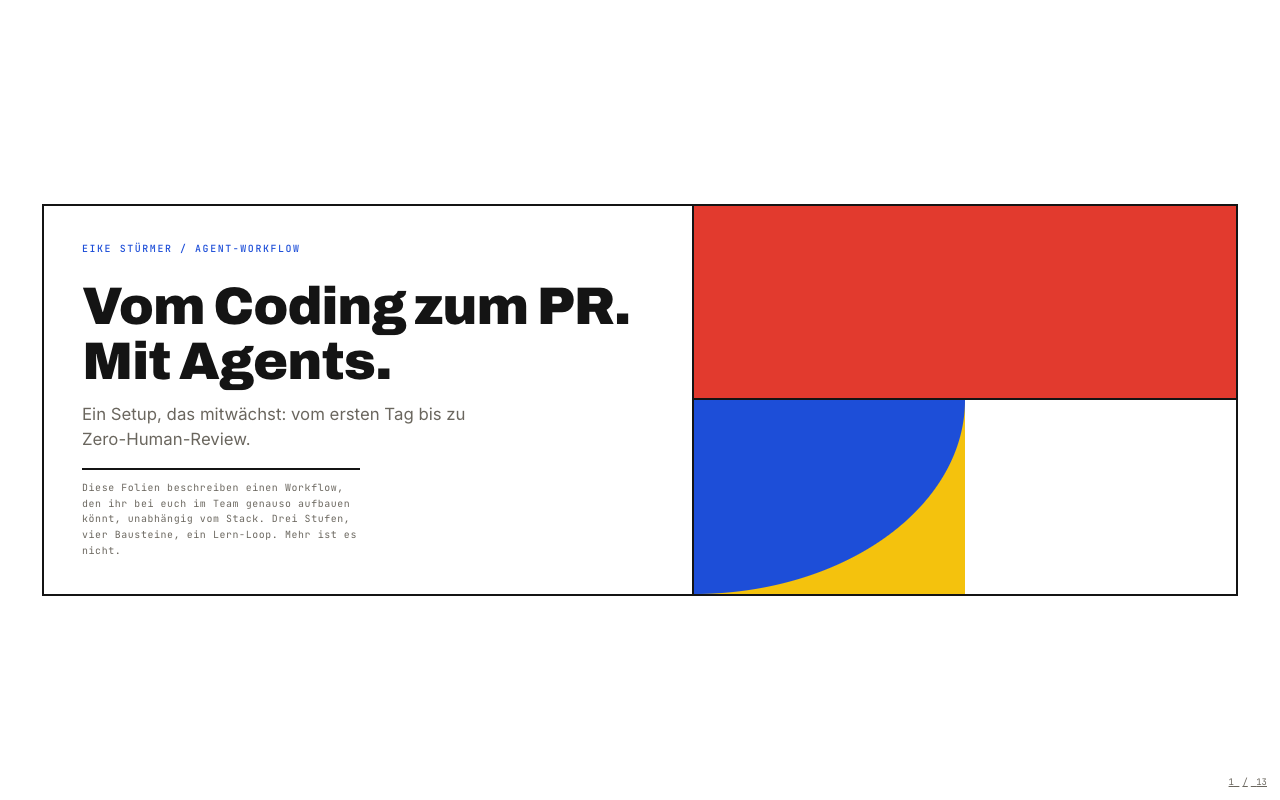 Deck · 13 slides
13 slides (in German) on the path toward Zero-Human-Review: phases 0 to 3, the learning loop of journal and observability, and a checklist of the artifacts you start with.
My background is data engineering. That is where weak handoffs, shallow reviews, and fragile pipelines get expensive early. The patterns behind it apply in any stack.
Eike Stürmer
I am Eike. I work where ways of working and code meet. My goal is a setup that keeps moving without outside help after a short period of shared work.
Exhibition 1994–2034 // Grid // Terrain // Test pattern // Field // Organization theory meets agentic coding //